

School Physicals: What Happens If Your Child Doesn’t Pass?
At Pediatric Care of Four Corners, Dr. Eiman ElSayed and our team ensure that every child receives a thorough sports physical. If your child doesn’t pass their school physical, we provide clear next steps, including possible follow-up appointments, further medical evaluations, or treatment for any underlying issues. We are here to support you and your child through the process. For more information, contact us or schedule an appointment online. We are conveniently located at 2516 Sand Mine Rd, Davenport, FL 33897.
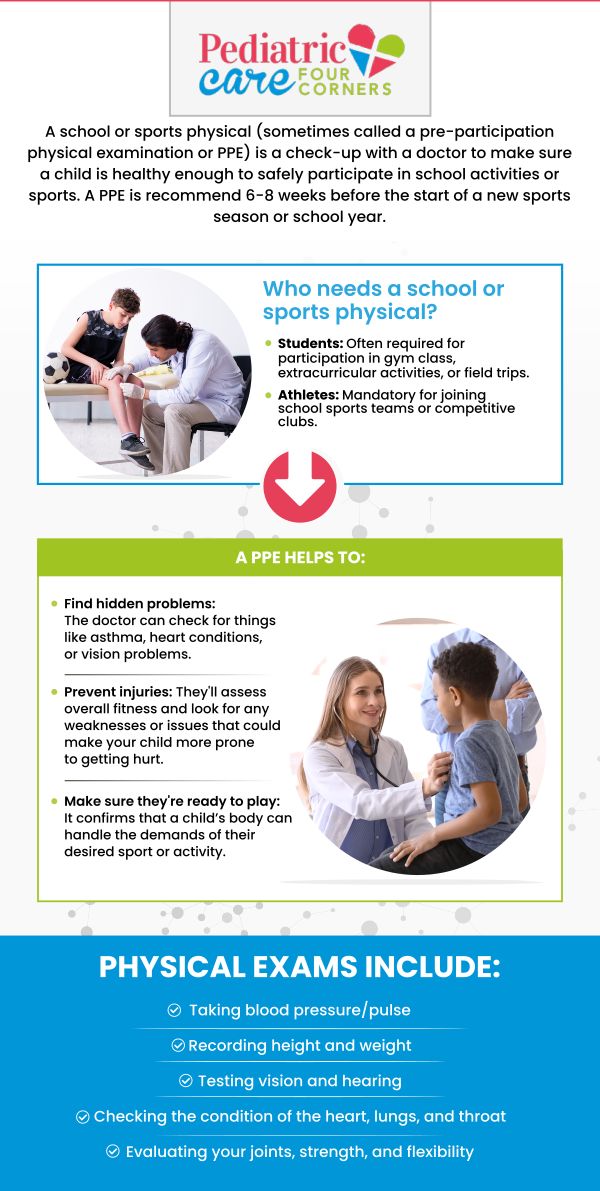
Table of Contents:
Does failing a school physical mean my child cannot attend school?
What are common reasons a child may not pass?
Can my child still play sports after not passing initially?
Will the school be informed about the specific medical issue?
What to Do if Your Child Doesn’t Pass Their School Physical with Dr. Eiman ElSayed
Failing a school physical does not automatically mean your child cannot attend school. A school or sports physical is a health check designed to make sure children are safe and ready for school activities, particularly physical education and sports participation. The main goal is to identify any health concerns that might require follow‑up care, not to bar children from coming to class.
When a provider at Pediatric Care of Four Corners identifies something that needs additional attention — such as a vision issue, high blood pressure, or an unresolved injury — the school may be notified in terms of what your child needs but not as a reason to exclude them from attending. In many cases, the healthcare provider will recommend:
● Follow‑up appointments (for example, with a specialist or for additional testing),
● Temporary restrictions on certain activities until an issue is resolved,
● Or guidance on home care while the child continues regular school attendance.
Schools generally require physicals to protect the health and safety of all students, and the documentation from the physical helps them know if there are modifications or accommodations your child might need.
For example, if your child is cleared for academic classes but needs to avoid strenuous physical activities temporarily, a note from the provider will explain what is safe. This approach ensures your child stays in school while any health concerns are addressed.
The team at Pediatric Care of Four Corners works with you and, when necessary, your child’s school to ensure that health findings are communicated appropriately and do not interfere unnecessarily with your child’s education.
A child “not passing” a school physical generally means that something was flagged during the exam that requires attention before full participation in certain activities, particularly sports. Common reasons this can happen include:
1. Unresolved or New Physical Concerns
Joint pain or instability: If a child reports pain or limited range of motion in an ankle, knee, shoulder, or back, the provider may recommend follow‑up care before participation in strenuous activity.
Respiratory concerns: Wheezing, shortness of breath, or poorly controlled asthma may need adjustment of medication or breathing tests.
Heart murmurs or irregular heart sounds: These are often benign but may require a closer look, especially if symptoms like dizziness or chest pain are present during activity.
2. Vision or Hearing Issues
Uncorrected vision or hearing problems can affect safety in school and on the field. If something is noted, a referral to an eye or ear specialist may be recommended.
3. Missing or Incomplete Vaccinations
Some schools require up‑to‑date immunizations for enrollment or participation in school activities. If records are incomplete, the provider will note what’s needed.
4. Lack of Recent Medical Records
If you did not bring your child’s medical history or vaccination records to the physical, the provider may not be able to complete the required documentation until those are obtained.
5. Acute Illness or Infection
If your child has a fever, contagious rash, or other signs of an active infection at the time of the exam, the provider may recommend waiting until the illness resolves before clearing them.
These issues do not usually mean your child “failed” in a permanent sense — they mean that something needs to be addressed or documented so that school and sports activities can proceed safely.
At Pediatric Care of Four Corners, providers take time to explain exactly what was found, why follow‑up is needed, and how to resolve it efficiently so your child can be cleared.
In most cases, your child can still play sports after not passing the initial physical, once the identified concern has been addressed. A school physical is intended to ensure safety; if something comes up during the exam, it usually means that the provider needs either:
● Additional information,
● A short course of treatment,
● Or confirmation that the issue is benign before clearance can be given.
For example:
● If the physical flagged a possible ankle weakness, the provider may recommend a short period of rest, physical therapy, or a follow‑up exam to ensure the joint is stable. Once the provider determines it is safe, your child can be cleared to play.
● If your child’s vision screening was abnormal, an eye exam and updated glasses prescription may be needed before full clearance.
● If asthma symptoms were noted, adjusting asthma medication and demonstrating good control may allow clearance.
The important thing to understand is that a school physical is protective, not punitive. Most “did not pass” scenarios are temporary, and once steps are taken to resolve the concern, the provider simply updates the clearance and sends documentation to the school.
At Pediatric Care of Four Corners, the team often assists families in coordinating these follow‑ups and ensuring kids are returned to play as safely and quickly as possible, with clear communication to coaches and schools as needed.
Information shared with the school following a sports or school physical is handled carefully and confidentially, in accordance with privacy standards and in the best interests of the child.
Here’s how it typically works:
Medical Information and Privacy
Healthcare providers like those at Pediatric Care of Four Corners are bound by patient privacy laws (such as HIPAA). They can share only what is medically necessary with the school. This means:
● If your child needs modifications or restrictions (e.g., avoid vigorous running for a few weeks while healing), that information may be communicated to the school.
● If your child is fully cleared, the school receives a clearance form that states the child is medically safe to participate in school and sports activities.
Limits on Disclosure
Providers do not share your child’s complete medical history or sensitive health information with the school unless you have given specific consent for them to do so.
For example, if your child has asthma that requires daily medication, that information may be provided to the school nurse so that proper medication can be administered if needed during school hours — but providers do not share full clinical notes or personal health details beyond what is necessary for safety.
Communication With Parents First
In most cases, your provider will discuss the physical findings with you first. You and your provider can decide together what information should be shared with the school, especially if accommodations are necessary (e.g., extra water breaks, easing into activity, or individualized care plans).
At Pediatric Care of Four Corners, clear communication is emphasized — providers help families understand what needs to be shared with schools and why, so parents are fully informed and comfortable with the process.
If your child doesn’t pass their school physical, Dr. Eiman ElSayed at Pediatric Care of Four Corners provides clear guidance on what steps to take next. Whether further medical evaluations, treatments, or lifestyle adjustments are needed, Dr. ElSayed ensures that you understand the process and works with you to help your child pass their physical and be ready for sports participation. For more information, contact us or schedule an appointment online. We are conveniently located at 2516 Sand Mine Rd, Davenport, FL 33897. We proudly serve patients from Davenport FL, Haines City FL, Poinciana FL, Winter Haven FL, and surrounding areas.
Check Out Our 5 Star Reviews





 Send Text
 How May I Help You?